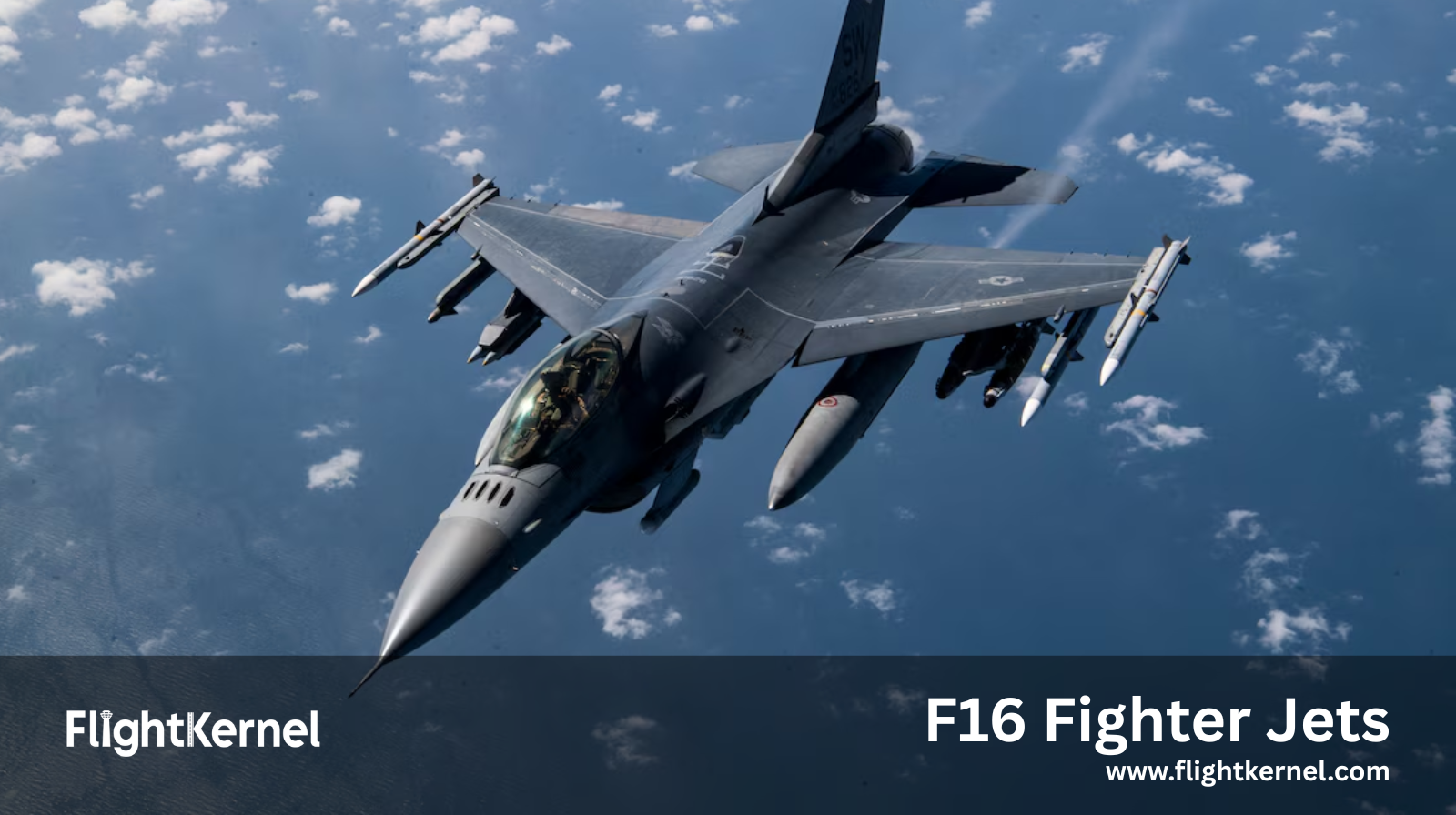
Let’s Get to Know About F16 Fighter Jet – The Lightweight Multirole Fighter
Few fighter aircraft have remained as recognizable, successful, and widely used as the F16 fighter jet. This has gone from being a revolutionary lightweight aircraft to one of the world’s most widely operated fighter jets. Founded by the US, F16 was developed and introduced first in the 1970s. It is now called Lockheed Martin.
But what makes the F-16 so special? How fast can it actually fly? What is inside the F-16 fighter jet cockpit, and why are countries still interested in this aircraft even decades later?
Let’s take a closer look.
What Is Special About the F-16 Fighter Jet?
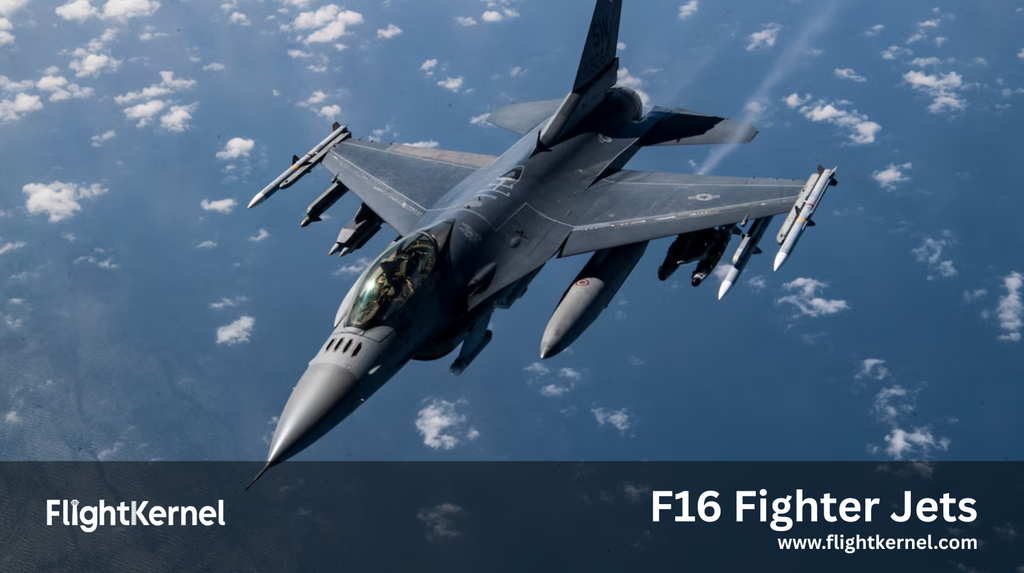
F-16 Fighting Falcon was developed by General Dynamics for the US Air Force as a relatively lightweight, highly maneuverable multirole fighter.
Its biggest innovation was its fly-by-wire flight-control system, which replaced many traditional mechanical controls with electronic ones. This allowed pilots to control the aircraft more precisely while performing demanding maneuvers.
The F-16 was also designed around the pilot. Its bubble canopy provides excellent visibility, while the side-mounted control stick allows the pilot to operate the aircraft easier.
In other words, the F-16 was not simply built to fly fast. It was designed to make a highly maneuverable fighter easier for a pilot to control.
F-16 Fighter Jet Models: How Many Are There?
There isn’t just one F-16. Over the decades, the aircraft has evolved through numerous versions and upgrades.
Some important F16 fighter jet models include the F-16A and F-16B, which were among the original variants. Later came the F-16C and F-16D, featuring improved avionics and greater multirole capabilities.
Modernized versions such as the F-16V introduce significantly upgraded electronics, including advanced radar and cockpit systems.
The aircraft has also been adapted for different operators. This means that two F-16s belonging to different countries may have substantially different equipment despite sharing the same basic design.
Inside the F-16 Fighter Jet Cockpit
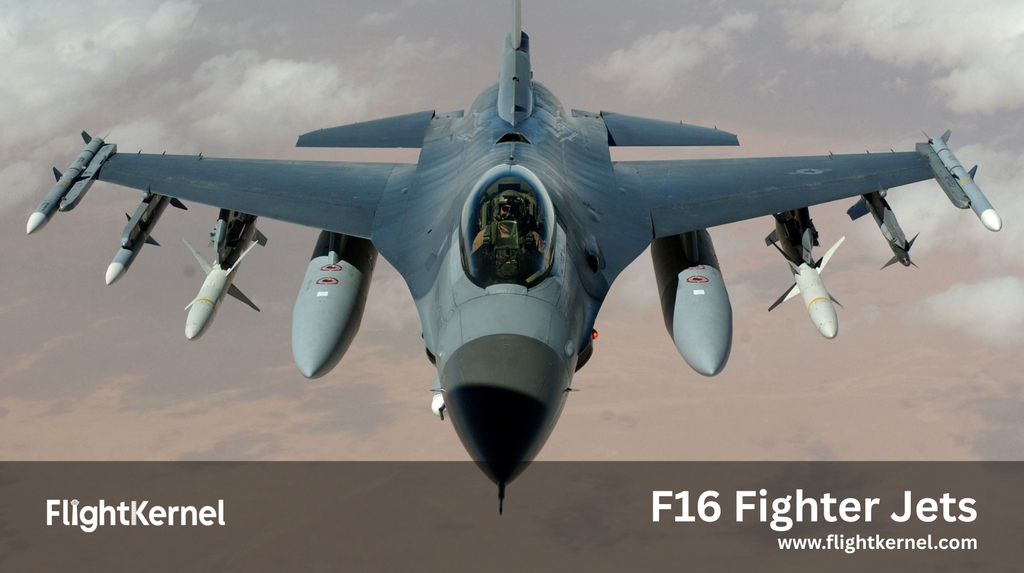
The F16 fighter jet cockpit is one of the aircraft’s most interesting features.
Instead of surrounding the pilot with a traditional collection of analog instruments, newer F-16 versions use modern multifunction displays. Digital systems to provide information about navigation, weapons, aircraft status, and threats.
The pilot sits beneath a large bubble canopy, giving an unusually wide field of view. The aircraft’s head-up display also allows important flight and targeting information to appear within the pilot’s forward line of sight.
This combination of visibility, electronic controls, and information displays helps explain why the F-16 became such an influential fighter design.
How Fast Is the F-16?
Now for the question everyone asks: what is the speed of F16 fighter jet?
The F16 fighter jet top speed is approximately Mach 2, or around 1,500 mph (2,400 km/h) at high altitude, depending on the configuration.
That means the aircraft can travel roughly twice the speed of sound.
However, maximum speed is not everything in aerial combat. Acceleration, maneuverability, radar, weapons, pilot training, and situational awareness can be just as important.
F-16 Fighter Jet Size: Is It Actually Small?
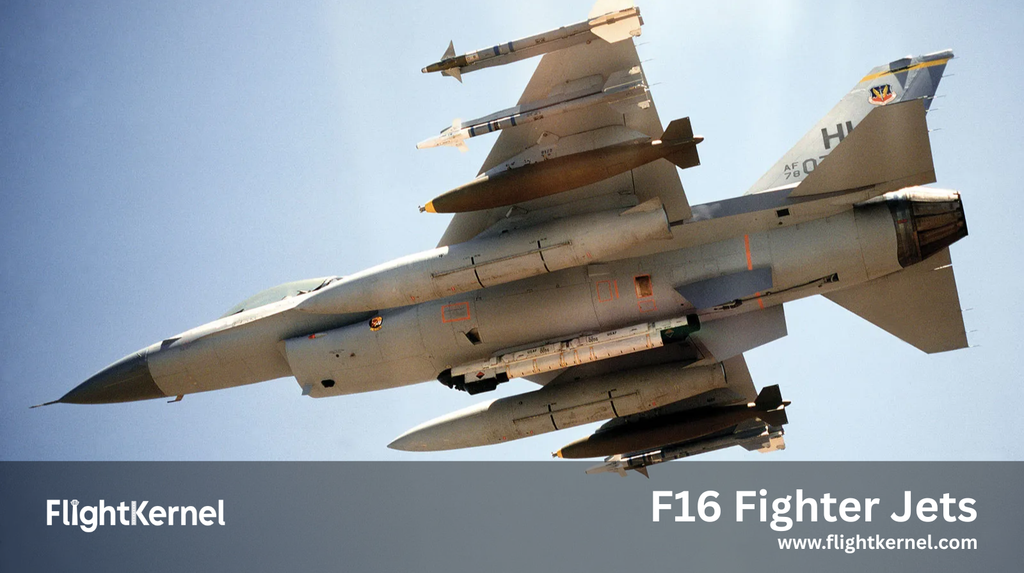
Compared with some larger modern fighters, the F-16 is relatively compact.
The F16 fighter jet size varies slightly between versions, but the aircraft is roughly 15 meters long with a wingspan of about 9.5 meters.
Its relatively lightweight design was intentional. The idea was to create a fighter with a high thrust-to-weight ratio and excellent maneuverability rather than simply building the biggest aircraft possible.
That philosophy helped give the F-16 its famous agility.
What Is the Price of an F-16 Fighter Jet?
So, how much does one actually cost?
The price of a F16 fighter jet depends heavily on its version, equipment, weapons, support package, training, and maintenance requirements. The aircraft itself can cost millions of US dollars, while a complete procurement package can reach considerably higher figures.
This is also why searching for an F16 fighter jet for sale is not quite like shopping for a used car. F-16s are military aircraft subject to government approval, export restrictions, contracts, and strict regulations.
In practice, countries generally acquire them through government-to-government defense agreements rather than simply purchasing an aircraft from a public marketplace.
Which Country Has F-16 Fighter Jets?
One of the biggest reasons for the F-16’s fame is its international reach.
The aircraft has been operated by numerous countries across Europe, Asia, the Middle East, and other regions. Operators have included the United States, Türkiye, Israel, South Korea, Singapore, Pakistan, Poland, Greece, Romania, Taiwan and several others.
This widespread adoption also reflects the aircraft’s ability to be upgraded over time rather than becoming obsolete after a single generation.
What Generation Is the F-16 Fighter Jet?
The F16 fighter jet generation is generally associated with the fourth generation of fighter aircraft.
It was revolutionary for its time, introducing technologies such as fly-by-wire controls and advanced maneuverability.
Modern upgraded F-16s, however, have received technologies that make them far more capable than the original aircraft. This is an important distinction: an aircraft’s original generation does not necessarily tell you everything about the capabilities of its latest upgraded version.
Has F-16 Jets Ever Crashed?
Like every high-performance aircraft, the F-16 has experienced crashes throughout its operational history.
An F16 fighter jet crash can occur because of many different factors. They include mechanical problems, adverse weather, pilot error, bird strikes, combat damage, or accidents during demanding training exercises.
Importantly, a crash does not automatically indicate that the aircraft itself is poorly designed. Fighter jets operate under extreme conditions, often performing maneuvers and missions far beyond what civilian aircraft experience.
What Is Stronger, F-15 or F-16?
Well, the answer to this question depends on what you mean by “stronger.”
The F-15 Eagle is a larger air-superiority fighter designed around powerful engines, long-range performance, and carrying a substantial weapons load. The F-16, meanwhile, is smaller, lighter, and designed as a highly maneuverable multirole fighter.
So, if you’re comparing raw size, payload, and air-superiority capability, the F-15 generally has the advantage. If you’re looking for a smaller and highly agile multirole fighter, the F-16 has its own strengths.
Which Is Better, F-16 or Rafale?
This comparison gets even more interesting.
France’s Rafale is a newer twin-engine multirole fighter with advanced sensors, electronic warfare capabilities, and a large weapons capacity. F-16 is older but has undergone decades of continuous upgrades and benefits from an enormous global operator and support network.
Hence, which is better solely depends on the mission, configuration, weapons, sensors, budget, and pilot training!
Final Thoughts on the Remarkable Legacy of F16 Fighter Jet
The F-16 may no longer represent the cutting-edge of fighter design in the way it did during the Cold War. But that is precisely what makes its story fascinating.
Few fighter aircraft have managed to remain relevant for so long. F16 remains known for its unusual cockpit and electronic flight controls to its Mach 2 performance and worldwide adoption. Hence it simply proofs that a successful aircraft does not necessarily need to be the newest aircraft in the sky!