Let’s Get to Know F47 Fighter Jet, Boeing’s New Sixth-Generation Fighter
Imagine a fighter jet designed to be faster, stealthier and more technologically advanced than the aircraft currently dominating the skies. And then imagine that most of its specifications are still classified. That is the intriguing reality behind the F47 fighter jet, Boeing’s next-generation fighter being developed for the US Air Force. Officially associated with the Next Generation Air Dominance (NGAD) program, the F-47 is intended to succeed the F-22 Raptor.
But what exactly is the new F47 aircraft? Has it actually flown? How fast will it be? Is it really better than the legendary F-22? Will it introduce a new era of air combat?
Let’s take a closer look and find the answers together!
What Is the New F-47 Aircraft?
The F-47 is a sixth-generation fighter aircraft being developed by Boeing for the US Air Force. In March 2025, the USAF awarded Boeing the Engineering and Manufacturing Development contract for the NGAD platform. F47 fighter jet name was officially given like that.
Unlike conventional fighter programs, NGAD is not simply about building a more powerful aircraft. The F-47 is intended to serve as the central, crewed component of a broader “family of systems”. It is meant to work alongside uncrewed aircraft, known as Collaborative Combat Aircraft.
In other words, the future fighter may not fight alone.
The F-47 could potentially coordinate with autonomous or semi-autonomous drones, share information across a battlefield. Their advanced sensors will be able to identify and engage threats before an opponent even realizes the aircraft is there.
That represents a major shift from the traditional idea of a fighter jet being a single aircraft with a pilot inside.
Is the F-47 a Real Aircraft?
Yes! The F-47 is a real military development program, not a fictional aircraft or merely a concept created for an airshow. Boeing has received the official development contract from the US government.
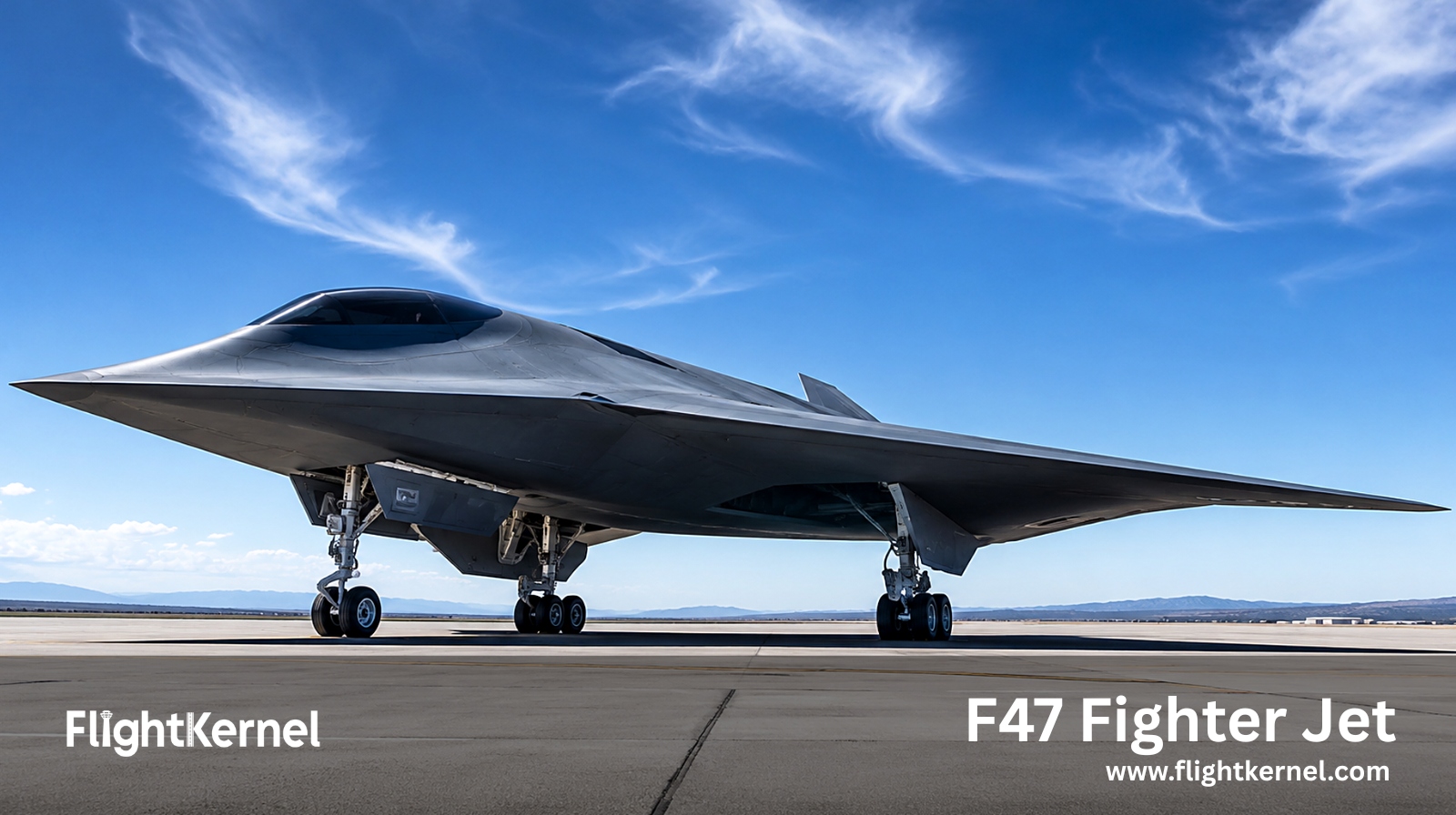
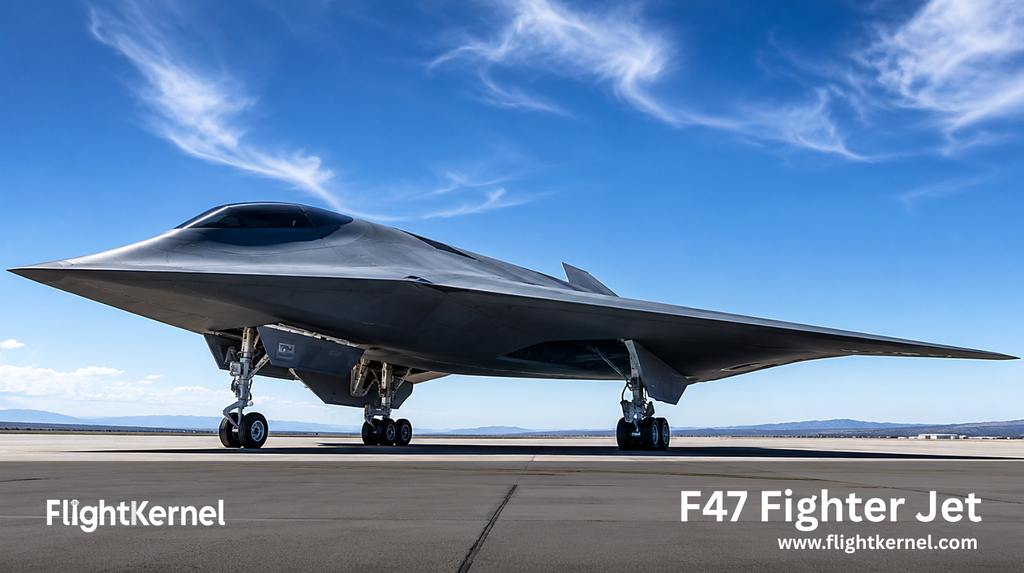
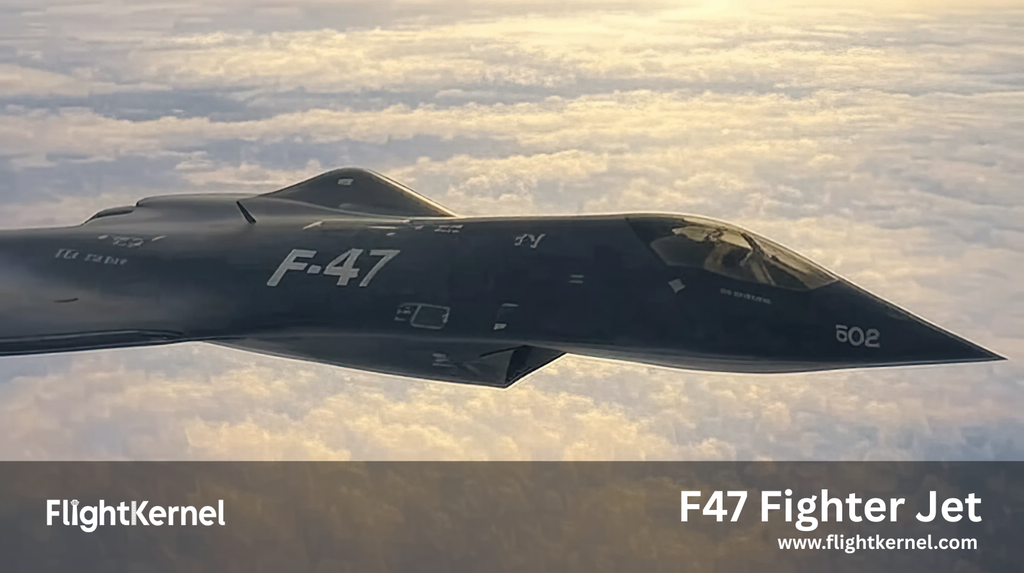
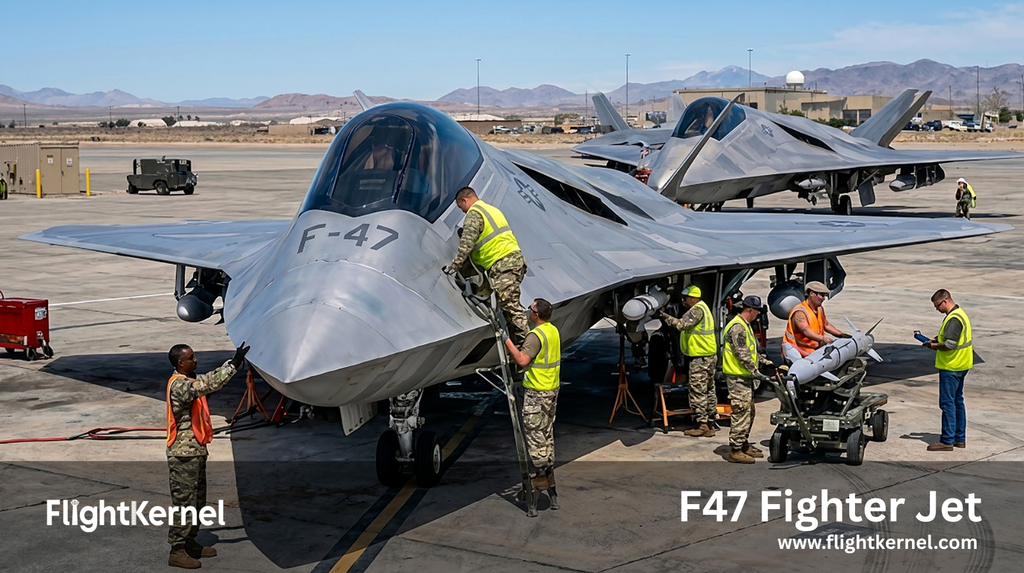
However, publicly available images of the F-47 are largely artist renderings, and many technical details remain classified. The USAF has also indicated that the program has already reached an unusually mature stage, but the operational aircraft is still under development.
So, if you see a dramatic image online claiming to be a photograph of the completed F-47, be skeptical. The real aircraft remains highly secretive.
Has the F-47 Flown Yet?
Here is where things get interesting.
The production F-47 has not publicly made its first flight yet. As of August 2026, the USAF is still working through the Engineering and Manufacturing Development phase, with the first flight expected in 2028.
However, this does not mean that the technology behind the program has never flown.
The USAF previously disclosed that NGAD technology demonstrators had been flown during the development process. These demonstrators were used to test technologies and concepts of the future aircraft, but they cannot automatically be considered operational F-47s.
F-47 Fighter Jet Specs
The biggest problem with discussing F47 fighter jet specs is that many of them remain classified.
Still, the USAF has publicly indicated some impressive targets. The aircraft is expected to have a combat radius exceeding 1,000 nautical miles, while its planned maximum speed is above Mach 2, meaning more than twice the speed of sound.
Its expected capabilities include:
- Advanced stealth and survivability
- Long-range air superiority
- High-speed performance
- Advanced sensors and networking
- Greater weapons and payload flexibility
- Integration with autonomous aircraft
- Adaptability for future technologies
The aircraft is also expected to be designed with future upgrades in mind. That matters because fighter jets can remain in service for decades, and technology can change dramatically during that time.
Rather than creating a jet that becomes outdated quickly, the F-47 is being designed around the idea of continuous technological evolution.
F47 Fighter Jet Speed
The exact maximum speed of Boeing fighter jets f47 has not been publicly confirmed.
However, the Air Force has stated that the F-47 will be capable of flying faster than Mach 2. This puts the jet speed in the supersonic category.
But speed alone is not what makes a sixth-generation fighter impressive. Modern air combat increasingly depends on stealth, sensors, electronic warfare, data sharing and situational awareness.
After all, a jet that knows where its opponent is before being detected itself can have a much greater advantage!
What About the F-47 Fighter Jet Engine?
The F47 fighter jet engine is another fascinating part of the program.
The US Air Force’s Next Generation Adaptive Propulsion (NGAP) effort is developing advanced adaptive-cycle engines for future fighter aircraft. Two major competitors, namely GE Aerospace’s XA102 and Pratt & Whitney’s XA103, are developing the designs.
Adaptive engines are designed to change how they operate depending on the situation. Simply, the engine could prioritize different characteristics such as efficiency, thrust or thermal management depending on what the aircraft needs.
That could be particularly valuable for a sixth-generation fighter expected to fly long distances, operate at high speeds and power.
However, the advanced NGAP engine is not expected to be ready for the F-47’s first flight. Current plans point toward integration around the 2030 timeframe, meaning early F-47 test aircraft may use an interim propulsion solution.
F47 Fighter Jet Capabilities
Stealth is perhaps the easiest feature to associate with the new fighter jet f47. But its real advantage could come from how several technologies work together. The aircraft is expected to combine stealth with advanced sensors, networking, long-range operations and autonomous teammates.
Think of it less as a traditional fighter and more as a flying command-and-control node.
A pilot could operate alongside several uncrewed aircraft, with those performing tasks like surveillance, electronic warfare or carrying additional weapons.
This means the F-47’s capabilities could extend far beyond what the aircraft itself physically carries.
Is the F-47 Better Than the F-22?
The F-47 is designed to replace the F-22, but saying it is simply “better” requires some context.
The F-22 Raptor remains one of the world’s most capable air-superiority fighters, combining stealth, supercruise, exceptional maneuverability and advanced sensors.
The F-47 is intended to take those concepts much further.
Its design emphasizes longer range, greater survivability, advanced networking, adaptability and cooperation with uncrewed aircraft. The Air Force has also described it as a sixth-generation fighter intended to dominate highly contested airspace.
But the F-47 has not entered operational service yet, so real-world comparisons cannot be made fairly.
Hence, for now, the F-22 has something the F-47 does not, which is the real-world experience!
How About the F47 Fighter Jet Cost?
The initial Boeing development contract has been reported at more than $20 billion, while the complete program is expected to become considerably more expensive over its lifetime. The USAF currently plans to acquire at least 185 F-47s, roughly matching the number of F-22s in the planned fleet.
However, there is no reliable publicly confirmed final “price tag” for each production F-47 yet. Estimates circulating online should therefore be treated cautiously.
And this is not simply the cost of manufacturing an aircraft. Developing an entirely new generation of stealth, propulsion, sensors, software and autonomous systems can cost billions before large-scale production even begins!
The Future of Air Combat…
Perhaps the most exciting thing about the F-47 is that it represents more than a new fighter jet. It represents a change in how the US Air Force imagines air warfare.
The F-22 was designed to dominate the skies. F-47 is being designed for a battlefield where stealth, range and human-machine teamwork may be just as important as speed.
The aircraft has not flown publicly yet, and many of its most important specifications remain classified. But the program is real, Boeing is building toward it, and the first flight is currently expected in 2028.
So, is the F-47 the ultimate fighter jet?
We don’t know yet.
But one thing is sure.
If the technology delivers as intended, the F-47 could make the traditional idea of a fighter jet look surprisingly old-fashioned!